 The Art of Tatum Vol 2
 Trio Work
 The Art of Tatum Vol 1

Art Tatum - pianist
Art Tatum (b. October 13, 1909 – d. November 5, 1956) was an American jazz pianist whose playing combined an exceptional command of the keyboard with an individual approach to harmony, rhythm, and improvisation. His career developed largely during the swing era, yet his recordings were studied by musicians from later generations, including pianists whose work became associated with bebop and modern jazz. Tatum recorded commercially from the early 1930s until shortly before his death, and his surviving recordings include studio sessions, radio broadcasts, concert performances, informal recordings, and privately made material.Art Tatum was born on October 13, 1909, in Toledo, Ohio. His eyesight was seriously impaired during childhood, probably as a result of cataracts. He attended the Jefferson School in Toledo for several years and later studied at the school for the blind in Columbus. He also attended the Toledo School of Music. His musical education included both jazz and classical material. He became familiar with the playing of pianists such as Earl Hines and James P. Johnson, while also studying the harmonic language of composers including Claude Debussy and Maurice Ravel.
Tatum was playing professionally while still a teenager. From 1927 to 1937, he performed on Toledo radio station WSBD, and from 1928 to 1929 his program was also heard nationally on the Blue Network. Radio played an important role in his early career, allowing listeners outside Toledo to encounter his playing before he became established as a recording artist.
His first commercial recordings were made in 1932. On August 5 of that year, Tatum participated in a session with singer Adelaide Hall, with pianist Lee or “Fats” Waller? No—this is one area where the surviving documentation needs to be treated carefully. The session with Adelaide Hall included Tatum and another pianist, and Tatum also recorded a demonstration of his solo performance of “Tiger Rag.” That recording was not released at the time. It appeared much later and was initially credited incorrectly.
Tatum's breakthrough as a recording artist came in 1933, when he recorded a series of solo performances for Brunswick. Among the best-known recordings from this early period is “Tea for Two.” His recordings demonstrated a conception of the piano that made it possible for a single performer to suggest several musical layers simultaneously. His left hand could establish a strong harmonic and rhythmic basis, while the right hand created elaborate melodic variations. His technique was not simply a matter of speed; his recordings show a highly developed approach to reharmonization, voice leading, rhythmic displacement, and variation.
His physical approach to the instrument was also unusual. According to the Library of Congress, Tatum had very large hands and could stretch to an interval of a twelfth. He commonly played with relatively straight fingers rather than the more curved hand position often associated with classical piano technique. He could distribute musical lines between his fingers in ways that allowed melody and accompaniment to sound simultaneously.
From 1934 to the middle of 1935, Tatum worked mainly in Cleveland. He then spent an extended period at the Three Deuces in Chicago in 1935–36. In late 1936 he moved to Hollywood, although he also returned to Chicago for another engagement. In late 1937 he moved to New York and began playing at clubs on and around 52nd Street.
In March 1938, Tatum and his wife sailed to England aboard the Queen Mary. He remained there for approximately three months. He performed on the British vaudeville circuit and appeared twice on the BBC television program Starlight. Four of his compositions were published in Britain during the visit. The trip increased his visibility among European audiences, although it was his only visit to Europe.
After returning to the United States, Tatum continued to work in clubs and to record. The latter part of the 1930s was also a period when relatively little of his recorded material was issued promptly. In August 1938, he recorded 16 sides that remained unreleased for many years. In 1939 he recorded another 18 sides, of which only two were issued as 78 rpm records at the time. The reason for this release policy is not completely certain, although the commercial dominance of big bands and vocalists during this period may have influenced record-company decisions.
Tatum's musical activities during the 1940s included both intimate club performances and larger concert events. He performed in the growing Jazz at the Philharmonic series organized by Norman Granz, which brought together leading jazz musicians in concert settings. Tatum's participation placed him in direct contact with musicians from different parts of the jazz world and with audiences beyond the club circuit.
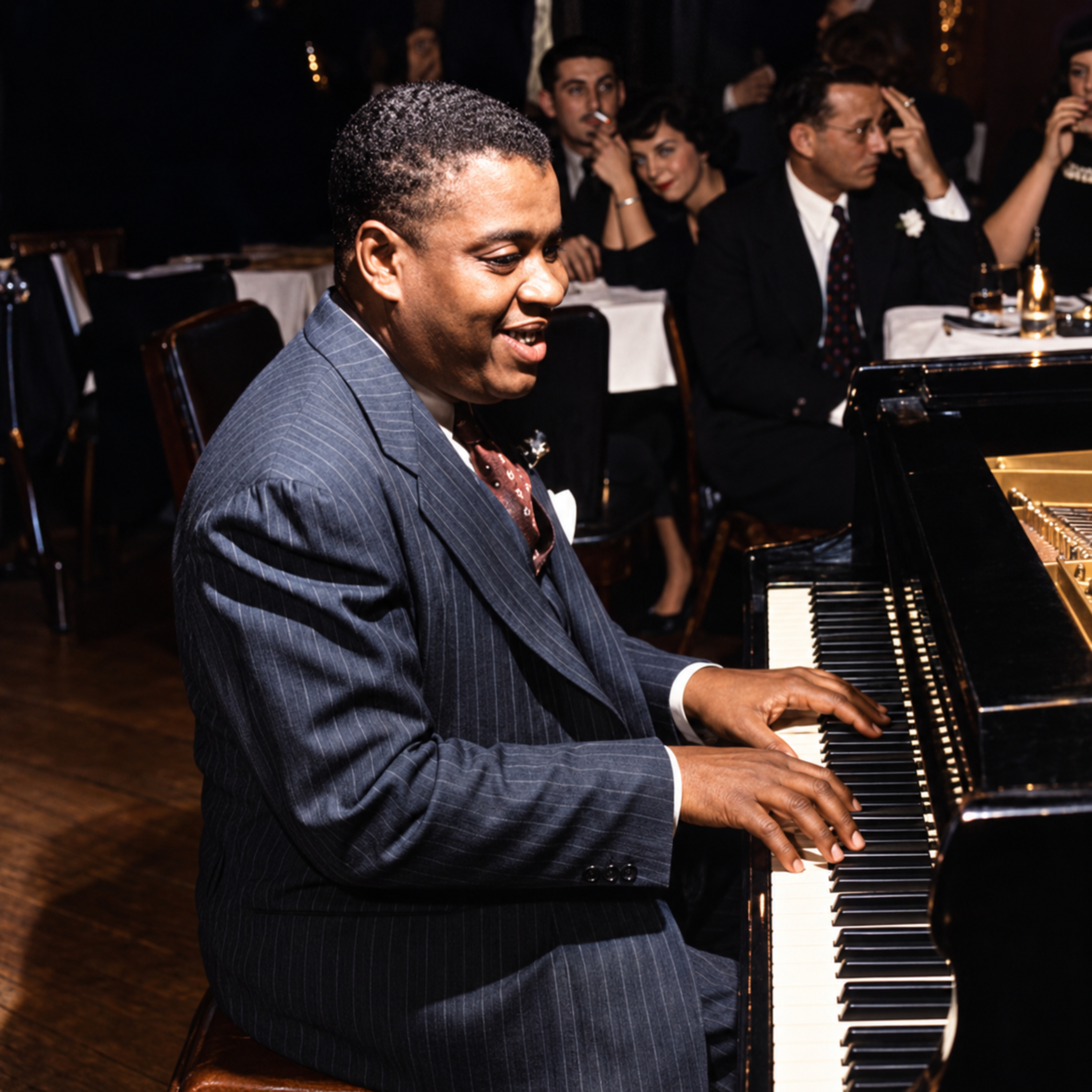
In 1944, Tatum was photographed at the Esquire All-Stars concert, and recordings of his trio from the same period have survived. Some of the surviving trio material was not originally issued. The Smithsonian's Folkways collection has subsequently published previously unreleased 1944 rehearsals by the Art Tatum Trio. These recordings document a more informal working environment than the commercial studio sessions.
A significant change came in 1949, when Tatum signed with Capitol Records. He recorded 26 pieces for the label during that year. He also appeared in the film The Fabulous Dorseys. One of the most important events of the year was a concert at the Shrine Auditorium in Los Angeles, recorded for later commercial release as Gene Norman Presents an Art Tatum Concert. The recording became one of the principal documents of Tatum's concert work.
Tatum's position in jazz was somewhat unusual by the end of the 1940s. The emergence of bebop introduced a new musical language associated with musicians such as Charlie Parker and Dizzy Gillespie. Tatum did not become a bebop musician in the conventional sense, and his popularity declined to some degree during the later 1940s. Nevertheless, younger musicians continued to regard him as an important pianist. His relationship to bebop was therefore not primarily a matter of stylistic participation, but of influence through his harmonic vocabulary, rhythmic freedom, and treatment of the piano.
Among the musicians who were deeply affected by Tatum's playing was Oscar Peterson. The Library of Congress recounts Peterson's reaction to hearing a Tatum recording for the first time and the importance Tatum subsequently assumed in his musical development. Peterson was not alone: pianists and other instrumentalists repeatedly listened to and analyzed Tatum's recordings as a way of understanding what could be done with harmony, melody, and rhythm.
Tatum also possessed a substantial repertoire of standard songs and popular melodies. Rather than simply reproducing a tune, he often treated the underlying harmony as a framework for extensive variation. Familiar songs could therefore become the basis for performances in which the original melody remained recognizable while the harmonic and rhythmic surface was continuously transformed. This aspect of his playing made his recordings particularly useful to later musicians interested in improvisation.
His recorded output remained active in the early 1950s. In addition to the Capitol recordings of 1949, Tatum continued to make recordings for Capitol in 1952 and for labels associated with Norman Granz from 1953 to 1956. The Granz sessions documented both solo performances and small-group work and form an important part of the later Tatum discography.
Tatum's health deteriorated during his final years. He had suffered from poor vision since childhood and also had diabetes. His heavy use of alcohol contributed to further health problems. Despite his declining physical condition, he continued to perform and record when possible.
Art Tatum died in Los Angeles on November 5, 1956, at the age of 47. His death ended a recording career that had begun in the early 1930s and had produced material across several different phases of the development of jazz.
Tatum's surviving recordings provide a record of a pianist whose musical language was formed largely before the emergence of bebop but whose influence continued through later developments in jazz. His approach to harmony, rhythmic organization, reharmonization, and piano technique made his recordings subjects of study for musicians long after they were originally made. The continued publication of previously unreleased radio, rehearsal, concert, and private recordings has also expanded the available picture of his work beyond his original commercial releases.